
Featured in Zhejiang Daily's People section, this young man from Xianju has become a sensation!
This story follows Zhu Shougen from Xianju, who started with a single flatbread and has now expanded to over 500 branches, while leading his hometown community toward prosperity.
This spring, Zhu Shougen returned home with his beloved shaobing (flatbread) to participate in the "Common Prosperity Initiative," sharing his craft to help more locals become prosperous. This earned him a new title: rural industrial revitalisation pioneer.
The lean man in an all-black trench coat demonstrates through practice that ”a palm-sized flatbread can hold infinite possibilities.” As founder of Zhu Agen Flatbread, Zhu has devoted most of his life to this craft—starting with one flatbread and expanding to more than 500 stores. Now, he brings his enterprise back home, pioneering the ”flatbread + rural revitalisation” model.
Reflecting on his journey with flatbreads, Zhu speaks with a sense of destiny: ”I’ve loved flatbreads since I was a child—every kind tastes delicious to me.” ”My roots are in Xiaye Village, Danzhu, Xianju. Long ago, people knew it as Flatbread Village but not as Xiaye.” ”Over a decade of travelling and making flatbreads helped me earn my first fortune”.
Among his partners, relatives, and friends, a different perspective emerges: ”He’s hardworking, eager to learn, and loves to explore. Ah Gen always finds the best in any product.” ”He’s daring, pairing flatbreads with coffee.” ”Working with Ah Gen, I cleared my debts and even bought a house.”
Perhaps combining these views captures the full picture. So-called ”destiny” is ultimately built bit by bit through hard work.
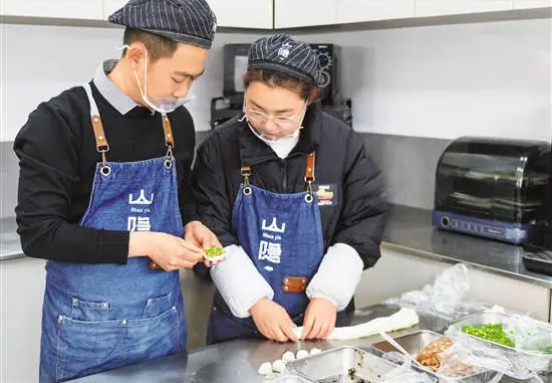
”The dough for a small flatbread must weigh 17 grams, and the meat filling at least 18 grams, so that every bite hits the filling.” Standing before the oven, Zhu’s hands act like scales, measuring dough and filling within a gram’s difference. He stuffs the dough, presses lightly, sprinkles sesame seeds, and rolls up his sleeves to press the flatbread against the scorching oven wall. Each movement makes his old burn scars appear even redder.
”You need to feel the oven’s energy to make better-tasting flatbreads,” he laughs, calling it the mark the flatbreads have left on him. In truth, it reflects his relentless pursuit of perfection.
Even now in a managerial role, whenever he has time, Zhu returns to the oven to experiment with new recipes alongside his technicians. From the size of the flatbreads to dough fermentation and filling selection, he has tried every step hundreds of times.
”When customers flocked to buy flatbreads, instead of focusing on baking, he mingled with them, asking about texture and taste.” His wife recalls that during the early shop days, he would often neglect business to seek customer feedback.
During those years, his wife served as a ”taster.” ”By day, he collected opinions; by night, he experimented,” she said. It was through batch after batch of refined flatbreads that the "Zhu Agen Flatbread’ brand was born. She came to understand that Zhu’s goal was simple: to make the flatbreads taste better, so that customers could ”taste the dedication.”
As the flatbreads improved, queues formed outside the shop. By 2013, daily sales exceeded 4,000 yuan, helping Zhu accumulate his first significant savings.
”Following Ah Gen’s lead in flatbread-making allowed us to settle debts, buy a new home, and see our son married,” said Xianju native Ying Chaoshang. Life became more fulfilling because ”Ah Gen shared every bit of his craft with us.”
Despite his generosity, some relatives and friends initially called him ”foolish.” When Zhu decided to open franchises, his first move was to openly teach his craft—a decision that caused quite a stir. ”If you share the craft, how will we sustain the business?” ”You’ll ruin the market!” ”The technique is the secret—it mustn’t be revealed!” Relatives, friends, and fellow tradesmen came in waves to persuade him, including his friend Ke Laowei.
”You want me as a partner, but you can’t even hold onto the craft. How will you make money?” Ke asked bluntly. Zhu replied, ”Do you want a quick one-time deal or a lasting business? Only by truly teaching others can we perfect the flatbreads, build a brand, and succeed in the long run.”
”If you’re not afraid of your craft being shared, why should I be?” Knowing Zhu’s obsession with flatbreads, Ke decided to take a chance. Together, they pooled funds and established a company.
When the first franchise fee arrived, Zhu gathered Ke and his family around a table with 5,000 yuan in cash. Confidently, he said, ”Our flatbreads will only get better. I hope our brand will flourish everywhere, like Shaxian snacks.”
From 2014 to 2017, Zhu expanded the business systematically: managing his own shop, training apprentices, standardising teaching, and eventually operating over 100 franchise outlets. They even targeted family-run shops, continuously experimenting with new business models to unlock more possibilities for the palm-sized flatbread and to help more people prosper through mastering the craft.
On his craft, Zhu says: ”It’s hard work,” but he adds, ”You reap what you sow. The toil is real, and so is the money you can save.”

During the interview, the word ”tinkering” appeared almost as often as ”flatbread”—both a description from others and a self-assessment.
Gen always says,” The world is so vast—you won’t know if it works until you try.l” Before partnering, Shi Teng only knew Ah Gen could make flatbreads. After partnering, he realised Ah Gen could scale the business because he dared to experiment and take risks.
In 2022, Shi Teng planned to open a coffee shop in a village in Xianju’s Danzhu Township and approached Zhu for a partnership. ”I hoped he’d invest some money, but he offered ideas too.” Knowing Zhu had no experience with desserts, Shi Teng had prepared a pitch. Zhu agreed immediately, rendering it unnecessary—and returned with a long list of ”requirements.”
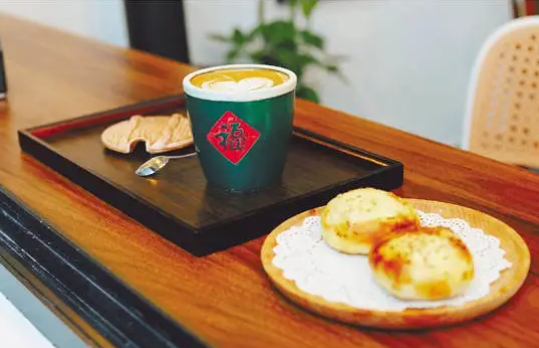
He insisted on pairing coffee with savoury buns, creating sweet buns, and locating the shop near mountains and water. Shi Teng initially thought, ”Is this even feasible?” Coffee was new to rural areas, and pairing it with flatbreads seemed ”half foreign, half local.”
Zhu took matters into his own hands, baking both savoury and sweet flatbreads, and brought them with coffee to demonstrate. ”Words are useless—you must taste it yourself.” Over the years, he explored pairing other snacks with coffee, confident his beloved flatbread could succeed.
One bite of a juicy beef mini-flatbread, followed by a sip of slightly bitter American coffee, convinced Shi Teng: ”It works.” The café, tucked at the foot of a hill opposite the main road, appeared secluded but attracted steady crowds. The beef bun and coffee combo especially drew young patrons who exclaimed, ”This pairing is perfect!”
The café’s success prompted Zhu to ask, ”What more can I do for my hometown?” A new idea emerged: to establish a filling processing factory in Xianju, bringing the supply chain home. ”Currently, the factory will focus on filling production, with future plans for deep-processing flatbreads and developing related souvenirs,” Zhu said. The first phase is set to invest 10 million yuan.
As new projects continue, Zhu’s cross-industry journey widens. Now serving as Executive Vice President of the Hangzhou Xianju Chamber of Commerce, he aims to help more people prosper. In 2023, Xianju launched the "Xianxiang Shared Prosperity Initiative," with a 10-year plan. The initiative sets up a dedicated fund, with Zhu Agen contributing over one million yuan annually. Franchisees from Xianju pay the minimum fee and receive financial support. Zhu Shougen plans to explore all future possibilities of flatbreads with a growing number of collaborators.
Translator:Ivan