
Taizhou: Where Lucid Waters and Lush Mountains are Invaluable Assets
This year marks the 20th anniversary of President Xi’s renowned vision that “lucid waters and lush mountains are invaluable assets.” The idea carries a simple yet profound truth that safeguarding nature is safeguarding growth, and a better environment leads to better development. It points the way towards a new path where economic growth and ecological preservation advance in harmony for greener development.
Together with us to explore how cities in Zhejiang prioritize ecological preservation and green development. Especially in Taizhou, a city between mountains and the sea, where lucid waters and lush mountains are truly invaluable assets.
Encircled by rolling hills and threaded with clear streams, Yanxiapan Village in Hengdu Town, Sanmen County, Taizhou, welcomes visitors whenever the weather clears. People capture the picturesque scenery on their phones and share it online.
The beauty of life is not just for the screen. Under the Beautiful Taizhou Initiative, the city has been dedicated to environmental improvement and balanced urban-rural development. This is a vivid example of Taizhou’s ongoing commitment to sustainability.
Taizhou has consistently ranked among China’s top cities for air quality and won 7 times the Zhejiang “Dayu Ding” award for excellent water management. Located in the birthplace of the green development philosophy that “lucid waters and lush mountains are invaluable assets”, Taizhou has spent the past 20 years putting this vision into practice, tackling pollution, reducing carbon emissions, and promoting pilot reforms and innovations. Taizhou is taking on a fresher look with clear sky, green hills, and lucid waters.

▲ Panoramic view of Shangdachen Island, Taizhou. Photo by Wu Junhua
Ecology on the Rise
Taizhou resident Chen Jiaqi brought her daughter to Yuhuan Xuanmen Bay National Wetland Park on a sunny day. The lake shimmered under the light, and birds flitted across the water as her little girl ran along the boardwalk, full of joy and curiosity.
In April 2024, Yuhuan Xuanmen Bay National Wetland Park held its first East China Sea Birdwatching Season. During the event, a rare visitor — the ferruginous duck — was spotted in the Phase III reclamation area, marking its first recorded appearance in Zhejiang. This globally vulnerable species was seen here farther north than anywhere else recorded, highlighting the remarkable recovery of the local ecosystem.
Taizhou’s improved environment is reflected in its air quality. In 2024, the city’s Air Quality Index (AQI) stood at 2.84, ranking third in the province. The air was rated “good” 94% of the time, placing fourth in Zhejiang, with an average PM2.5 concentration of 24.1 micrograms per cubic metre.
As the sky grows clearer, Taizhou is also stepping up efforts to improve its water environment.
Taizhou has focused on improving water quality with targeted actions to tackle pollution and eliminate severely contaminated Class V water bodies. The city has set up “zero direct-discharge” zones for wastewater, promoted the Beautiful Rivers and Lakes initiative, and restored ecological buffer zones along rivers and lakes. Drinking water sources have been standardized, and Taizhou has become a national pilot city for regional recycled water reuse. These efforts have delivered impressive results: in 2024, 93.8% of monitored water sections met or exceeded quality standards, surpassing the annual target by 3.2 percentage points and reaching a record high, while all province-monitored handover sections fully met the required standards.
Taizhou has also led the province in innovative environmental management. The city was the first to implement the “Three Lines, One List” system, which sets clear boundaries for ecological protection, resource use, and environmental quality, and has applied it through digital tools to better monitor and enforce regulations. Taizhou also pioneered a streamlined, single-permit system for pollution discharge and simplified environmental impact assessments. Using an innovative “IoT + blockchain” approach, the city has solved the challenges of collecting and disposing of hazardous waste from small businesses, ship wastewater, and medical waste.
As Taizhou’s environmental protection efforts grow stronger and its ecosystems recover, rare and protected species are increasingly making their home in the city.
Since 2019, Taizhou has been conducting comprehensive biodiversity surveys. The city’s key nature reserves are now home to 53 nationally protected plant species, including two under the highest protection level: the Chinese water shield and the southern yew. Among animals, 108 species are nationally protected, with 19 at the top protection level, including pangolins, yellow-bellied tragopans, Chinese merganser, and black-faced spoonbills.
Coordinated Carbon Capture on Land and Sea
At the central fishing port in Taizhou’s Jiaojiang District, fishermen log into the public service APP, using the “Fisheries Made Easy” feature to request collection of pollutants as soon as they return to shore. Specialized vehicles quickly arrive to transport the waste to the “Marine Cloud Warehouse”, where oil and other contaminants are safely separated and treated.
For fishermen working near Dachen Island, this has become second nature, as oil and other waste from their boats can affect the waters around the island’s bays.
The “Marine Cloud Warehouse” smart pollution-control model was pioneered by Jiaojiang District in 2019, using intelligent equipment, big data, and blockchain technology to streamline the collection, transport, and monitoring of pollutants. By 2022, the system was integrated with the feature “Fisheries Made Easy” on the public service APP, allowing real-time monitoring of pollutant collection, transfer, and disposal, and enabling smart management for every vessel.
To tackle marine plastic pollution, Jiaojiang District has explored a new collaborative model on Dachen Island that brings together government, businesses, industry, and the public. The initiative creates an integrated system for collecting waste at sea, recycling it, and linking the process to carbon credit trading, turning marine waste into both environmental and economic value.
In March this year, Taizhou introduced local standards for marine blue carbon with the release of the Coastal Carbon Accounting Guidelines, supported by a digital accounting system that fills a gap in national practices. At the same time, the city established a revenue-sharing plan, directing over 40% of carbon credit income back into island ecosystem protection.
Taizhou’s efforts have won widespread recognition. Initiatives launched in Jiaojiang District received the UN’s highest environmental honor, the “Champions of the Earth”, while the marine blue carbon pilot project earned the Bronze Award for Reform and Innovation from Zhejiang Province, highlighting the city’s leadership in sustainable marine management.

▲The coastline of Wenling
By turning sustainability into a strength, Taizhou is creating a new model where pollution reduction and carbon cutting go hand in hand.
In Taizhou Bay’s pharmaceutical and chemical park, rows of reactors and winding pipelines operate without any harsh chemical smells. Large screens track real-time carbon emissions, while a smart system manages the entire park with precision. This national pilot project for coordinated pollution and carbon reduction is putting green innovation at the heart of industry.
In just a few years, the Taizhou Bay Pharmaceutical and Chemical Park has launched 20 green, low-carbon technology upgrades and 14 coordinated environmental management projects. Together, these have reduced carbon emissions by approximately 12,500 tons and established a full-process, end-to-end model for coordinated pollution and carbon reduction in the industry.
Green Development, Shared Prosperity
Taizhou is promoting collaboration across all sectors and regions to ensure that the benefits of a healthy environment are shared by everyone. Through comprehensive planning and inclusive management, the city now leads the province in ecological excellence, with all key areas recognized as models of sustainable development. This approach creates a green path where economic growth, improved livelihoods, and environmental protection walk side by side.
In Tiantai County, Tahe Village has reinvented itself through new rural industries. The village launched a water management and cleanup campaign and established a cooperative that combines eco-tourism, lotus harvesting, and aquaculture into a complete lotus pond experience. With government guidance, community involvement, market-driven operations, and a focus on sustainability, Tahe Village has transformed from a struggling community into a flourishing holiday destination. It has been honored as a National Key Rural Tourism Village and a Zhejiang Province “New Era Beautiful Village”.
In Xianju County, Linkeng Village residents have also felt the transformative impact of tourism, built on the village’s rich natural resources.
Once a village with a fragile local economy and widespread out-migration, Linkeng Village in Xianju County has undergone a remarkable transformation. Nestled against Gongyu Rock in the 5A-rated Shenxianju Scenic Area, the village has leveraged its prime location to develop rural tourism. Residents have established a tourism company and opened homestays and farm-style guesthouses, making use of idle homes and providing dining facilities for visitors.
Today, Lin Keng has emerged as a boutique tourism village, with homestays at its core and a harmonious mix of sightseeing, leisure, and wellness experiences. During holidays, visitors come in droves, drawn by the village’s charm and natural beauty. In recent years, Linkeng has earned numerous honors, including county-level Beautiful Village, featured homestay village, 3A-rated scenic village, and recognition as a model in Zhejiang Province for integrating ecological conservation with rural development.
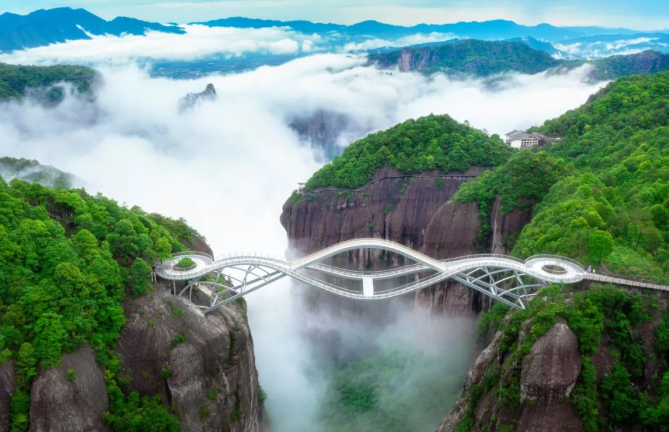
▲Shenxianju Scenic Area, Xianju County
In recent years, Taizhou’s ecological and environmental authorities stick to inclusive green prosperity across the city, laying a strong foundation for sustainable development and shared wealth. To support high-quality growth in mountainous counties, the city has implemented paired development programs—linking Luqiao with Tiantai, Wenling with Sanmen, and Yuhuan with Xianju—providing vital ecological support for building a model zone of shared prosperity. This approach has forged a path of green development for shared prosperity, where economic growth and social development align seamlessly with environmental protection.
By the end of last year, Taizhou had achieved remarkable progress, establishing 25 model villages for harmonious and beautiful countryside, 21 provincial-level pilot districts highlighting exemplary urban and rural landscapes, and 8 “New Era Fuchun Mountain” demonstration areas, showcasing the city’s commitment to sustainable, high-quality development across the region.
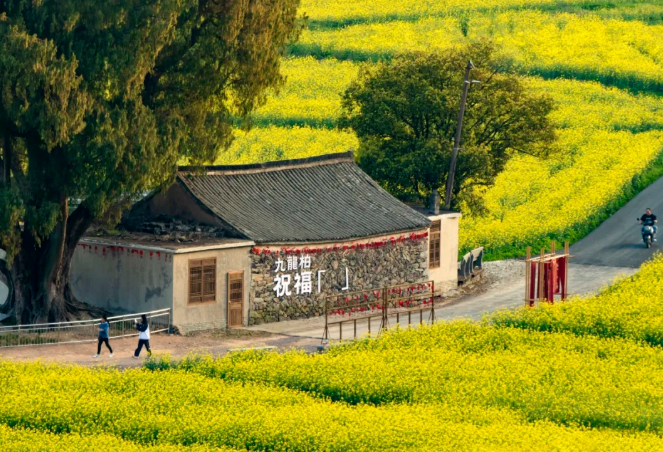
▲Jiangnan Creek Valley, Linhai County
Translator:JingJing Shi