
Sanmen Green Crab
During the Qianlong period (1736–1795), the village of Yuejing in Sili Township had already begun farming Sanmen green crabs, though the practice was intermittent. In 1901 (the 27th year of the reign of Emperor Guangxu of the Qing Dynasty), there is a written record stating: "An official order was issued to survey the tidal mudflats along the coast (suitable land for farming razor clams and crabs), and each household was assigned plots to cultivate under license." In 1946, Maotou Village established a "Central Government Aquaculture Office" to engage in razor clam and green crab farming. A local fishing proverb in Sanmen goes: "To get rich, rely on the tidal flats; to build a house, raise the king of crabs." After 1949, tidal flat fishing and farming gradually developed. Coastal fishermen adopted various methods to increase crab catch and yield, including net fishing (locally called "fang xie ling"), as well as "fang xie dong" – luring crabs into artificial burrows for molting and then catching them, especially when they were plump. Due to abundant resources, fishermen could not consume all the crabs and began devising ways to farm them. Initially, they used empty wine jars buried in the mudflats, placing crabs inside for cultivation, but yields were low. Later, they dug pits on the mudflats and covered them with stone slabs to provide shelter for molting crabs – a method known as "stone slab cabin" farming. In the early 1980s, artificial mud crab farming developed rapidly. Farmers invested substantial capital in building farming ponds, adopting various methods such as monoculture, polyculture, rotational culture, and intercropping. The farming area in Sanmen County expanded quickly. In 2000, Fang Town and Haiyou Town in Sanmen County were named "Hometown of Green Crabs" by the Zhejiang Provincial Government and the Provincial Bureau of Fisheries. By 2003, six major mud crab production areas in Sanmen County (covering over 10,000 mu, approximately 667 hectares) had obtained certification as Zhejiang Pollution-Free Agricultural Product sites.
Sanmen County, the place of origin of Sanmen green crab, has a subtropical monsoon climate. The production area is warm and humid with four distinct seasons, no severe cold or extreme heat. The annual average temperature is 16.8°C, annual rainfall reaches 1380.7 mm, and the average annual sunshine duration is 1600 hours. The production area is a semi-enclosed bay with a winding coastline and numerous inlets. The bay is calm, with vast tidal flats, soft mud, and moderate salinity. The salinity in the sea area typically ranges from 18 to 32. There are many coastal streams, abundant freshwater inflow, clean and pollution-free water, and rich bait organisms. Sanmen County has a coastline of 227 kilometers, shallow sea area of 590,000 mu (approx. 39,333 hectares), and tidal flat area of 210,000 mu (14,000 hectares). The microbial content in its seawater ranks among the highest in China's coastal waters, making it suitable for marine aquaculture. The county has a total aquaculture area of 239,000 mu (approx. 15,933 hectares), of which mud crab farming accounts for 95,000 mu (6,333 hectares). Its mud crab output accounts for about one-third of Zhejiang Province's total and one-ninth of the national total. Sanmen County is the largest marine aquaculture county in Zhejiang Province and has been named the Hometown of Green Crabs in China, as well as the Hometown of Prawns, Hometown of Oysters, and Hometown of Razor Clams in Zhejiang.
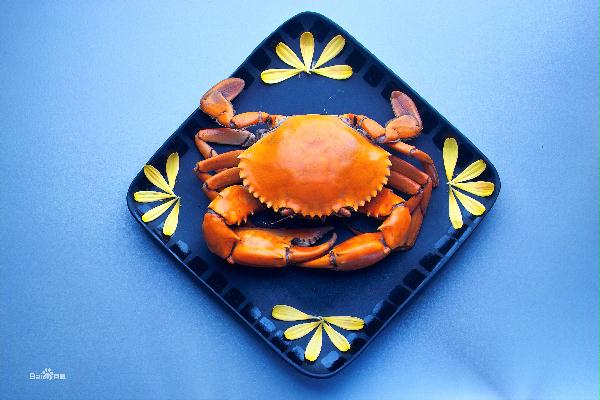
Sanmen green crab is a high-protein, low-fat food containing 18 amino acids. In addition to its culinary value, it has significant medicinal value. The meat and internal organs can be used to treat scabies, dermatitis, lacquer sores, damp-heat conditions, and postpartum blood stasis. Long-term consumption is said to promote diuresis and reduce edema, remove blemishes and beautify the skin, nourish yin and strengthen yang, making it an excellent health and beauty food.
Translator:Jiayang Lin