
Taizhou in Zhejiang, Connects with the World through "Hehe(Harmony and Unity)"
Plates, window flowers, murals, sculptures... In Taizhou, Zhejiang, the images of the "Two Immortals of Hehe" can be seen everywhere.
For many locals, the "Two Immortals of Harmony" have been a familiar sight since childhood: one immortal holds a lotus flower as a gift, while the other presents a round box in return. Their charming and cheerful expressions convey profound meanings. The lotus ("荷He") and the box ("盒He") are homophones for "和合Hehe" (harmony and unity), symbolizing people’s simple longing for harmony and happiness.
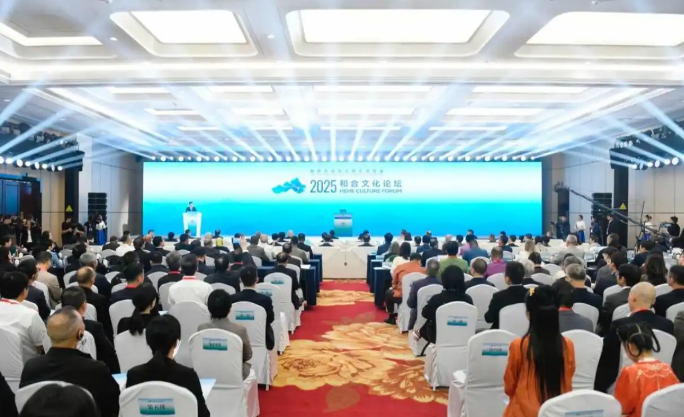
On November 1, the "2025 Harmony and Unity Culture Forum" was held in Taizhou. As one of the three major cultural heritages of Zhejiang, Taizhou’s harmony and unity culture is as renowned as Yangming Culture in Yuyao and Southern Confucius Culture in Quzhou. It is not only a vivid representation of Chinese harmony and unity culture but also deeply integrated into the city’s spirit, serving as a source of inspiration and driving force for its development.
Hehe(Harmony and unity)encompass values such as peace, harmony, amicability, and serenity. They have nourished the continuous growth of the Chinese nation while contributing Eastern wisdom to addressing contemporary challenges and resolving civilizational conflicts. In Taizhou, harmony and unity culture is not confined to history; through inheritance and innovation, it permeates all aspects of economic and social development, becoming a "cultural engine" that drives progress. This land offers a window for the world to gain insight into China.
The Beauty of Hehe, Nurturing Past and Present
In Taizhou, the dialogue on "Hehe" is growing louder and deeper in meaning.
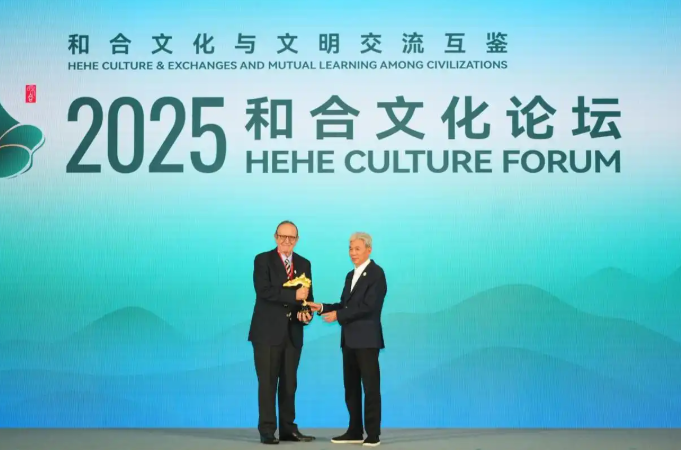
The Paper (www.thepaper.cn) noted that this year’s forum, themed "Hehe Culture and Civilizational Exchanges and Mutual Learning," brought together experts, scholars, and representatives from various fields worldwide to engage in in-depth discussions and explore pathways for win-win cooperation. Established in 2021, the forum has been held for five consecutive years and has become a well-known and influential platform for cultural exchange and intellectual dialogue both domestically and internationally.
According to public records, the concept of Hehe culture was proposed in the late 1980s and early 1990s. However, the Chinese nation’s emphasis on "harmony and unity" has a long history. For example, the characters "和He" (harmony) and "合He" (unity) appeared individually in oracle bone and bronze inscriptions. "和He" referred to harmonious sounds, while "合He" denoted the joining of lips. During the Yin and Zhou periods, both characters represented singular concepts.
Harmony and unity have longitudinally permeated the entire development of Chinese culture and horizontally integrated into the ideological and cultural traditions of various schools of thought, making them a vibrant essence of Chinese intellectual culture.
At the event, Zhao Cheng, member of the Standing Committee of the CPC Zhejiang Provincial Committee and Minister of the Publicity Department, stated that harmony and unity culture is the essence of China’s outstanding traditional culture, a shining emblem of Zhejiang’s cultural heritage, and a vital force for social development. The concepts of inclusiveness, prioritizing harmony, and working together for common goals embedded in harmony and unity culture help foster respect for differences, seek common ground while reserving differences, and achieve win-win cooperation in international relations, thereby identifying the greatest common ground for peaceful development.
Chang Bo, Director of the China International Communications Group, emphasized that Hehe culture holds historical significance as a core spiritual bond, demonstrates contemporary value in shaping China’s development path, aggregates practical achievements of Chinese modernization, and embodies human wisdom for creating a better world. Strengthening the interpretation and dissemination of harmony and unity culture carries significant global implications.
Thun Vathana, Second Vice President of the Senate of Cambodia, noted that China is a trustworthy partner, and the over-two-millennia-long historical ties between Chinese and Cambodian civilizations form a solid foundation for their friendship. He said, "Harmony in diversity leads to strength." By upholding the spirit of harmony and unity and resolving conflicts and differences through equal dialogue, we can jointly move toward a future of mutual understanding, peaceful coexistence, and shared prosperity.
The Paper observed that the forum also featured two sub-forums: "Hehe Wisdom and New Paradigms of Social Governance" and "Harmony and Unity Culture, Cultural Protection, Inheritance, Innovation, and the Application for UNESCO World Heritage Status of Mount Tiantai." Additionally, side events included the launch ceremony of the "Global Collection of Hehe Practice Cases," the release of the "Taizhou 'Hehe Journey' Inbound Tourism Route," the award ceremony for "Outstanding Overseas Hehe Culture Stations," and the release ceremony of the short drama "The Search for Heaven."
During the forum, the Academy of Contemporary China and World Studies under the China International Communications Group released the "International Communication Report on Hehe Culture." The report indicates that the concept of Hehe is increasingly becoming a mainstream cultural consensus internationally. The global dissemination of Hehe culture is entering a new phase characterized by deepening international recognition, more diversified communication pathways, and growing audience expectations.
The Path of Hehe, Beauty in Diversity
Exploring the enduring legacy of Hehe reveals many vivid examples.
Starting with Taizhou, a significant landmark and practice base of Hehe culture: Since the reform and opening-up, Taizhou has pioneered initiatives such as the joint-stock cooperative system, flourished through market development, thrived in opening-up, and advanced through entrepreneurship and innovation. Its pioneering private economy has driven regional economic growth, creating the remarkable "Taizhou phenomenon." Hehe culture has grown alongside the city, becoming a source of strength for Taizhou’s leapfrog development.
Shen Mingquan, Secretary of the CPC Taizhou Municipal Committee, stated that Taizhou is committed to developing a "Hehe economy," preserving a "harmony and unity ecology," and promoting "harmony and unity governance." Hehe culture has become a tangible and applicable governance wisdom, development momentum, and way of life in Taizhou, serving as the enduring spiritual code of the city. Taizhou will further advance the historical exploration, theoretical research, and cultural inheritance of harmony and unity culture, promote its social popularization and integration into daily life, actively serve and integrate into the new development paradigm, and continuously contribute to building a community with a shared future for mankind.
How can the concept of "Hehe" be realized in Taizhou, becoming a practical example of "beauty in diversity" for the city and its people? The ancient bayberry forest in Xianju County offers a vivid case study.
The ancient bayberry composite farming system in Xianju County, Taizhou, was recognized by the United Nations Food and Agriculture Organization in 2023 as the world’s first globally important agricultural heritage system in the bayberry category. Xianju County has developed a composite model of "interplanting bayberry and tea, raising chickens under the forest, and introducing bees for pollination": the chickens help control weeds and pests, while their manure enriches the soil; bees pollinate the plants, improving the quality of bayberries and tea, and also producing honey. Each species finds its place, forming an organically balanced and beneficial cycle system.
This not only yields higher-quality ecological products such as bayberries, tea, poultry eggs, and honey but, more importantly, vividly illustrates the ancient wisdom of "unity of heaven and humanity" embedded in Hehe culture. Here, humans are not mere takers from nature but protectors and coordinators, coexisting and thriving with all things, painting a beautiful picture of harmony between humanity and nature.
In the field of environmental protection, the concept of "Hehe" guides Taizhou toward a deeper "harmonious coexistence between humanity and nature." Taizhou has innovatively developed a "blue cycle" model for marine plastic waste governance, led by the government, driven by enterprises, coordinated across industries, and involving public participation. This model establishes a digital grassroots governance system for marine plastic waste, encompassing "market-driven waste collection—high-value resource utilization—internationally certified value addition." It achieves source control, low-carbon recycling, and high-value utilization of marine plastic waste. This project has won the United Nations’ "Champions of the Earth Award," providing a Chinese solution for global marine plastic waste management.
The principle of "harmony and unity" is also deeply integrated into Taizhou’s social governance practices. Taizhou’s "Hehe governance" mediation model builds upon the "harmony and unity" mediation approach of Tiantai District, incorporating advanced mediation practices from other counties (cities, districts). It strengthens the "one county, one brand" mediation initiative, accelerates the development of mediation organizations, improves team management, enhances quality and efficiency, and fosters brand building. The model aims to create a mediation system characterized by harmony as the foundation, harmony as the priority, harmony as the goal, and harmony as the beauty, ensuring that conflicts and disputes are "detected early and resolved at a small scale."
Taizhou’s diverse practices demonstrate that "Hehe" is not a dusty ancient teaching but a vibrant cultural force. It emerges from ancient imagery, integrates into the fabric of modern cities, and quietly grows amidst green mountains and clear waters, within neighborhoods, and in every dialogue seeking consensus. The path of harmony and unity is an endless book, continuously being written.
Translator:Jiayang Lin